In this era marked by post-truth, we find in quantum physics an unexpected language for thinking about the present. A world where matter can behave as both a wave and a particle, where observation transforms reality, and where apparent contradiction is part of how things work.
Quantum Compass is an installation in which we use quantum physics as a metaphor to reflect on how we construct meaning and how we relate to technology that challenges our intuition. The installation brings together three complementary pieces: Quantum Font, the first typeface based on quantum principles, capable of holding concepts in tension without reducing them to a single meaning; an interactive exploration of a quantum computer and its inner workings; and a hyperrealistic documentary that delves into the material foundations of the computer, its possibilities, and the real limitations of this technology.
Three approaches to the quantum: as a metaphor, as an experience, and as real technology.
Truth in Superposition
We live in an age in which algorithms transform biases and emotions into unquestionable facts, generating distinct and conflicting realities for each group. Like Schrödinger’s cat, facts seem to exist in a superposition of possibilities until we attempt to classify them, and that very attempt to pin them down to a single truth is precisely what fragments consensus and erodes democratic coexistence. In the face of this crisis, we propose coexistence as an alternative to certainty—a space where multiplicity does not lead to paralysis but to a sense of belonging, and where accepting difference, rather than seeking unanimous agreement, becomes the true foundation of social cohesion.
In this article, we develop this idea by drawing on critical theory and quantum mechanics—from Habermas and Foucault to Schrödinger and Le Guin—to propose uncertainty not as a deficiency, but as a starting point for democratic coexistence.
QUANTUM FONT
Writing Contradiction
Quantum Font is the first quantum typeface, inspired by the double-slit experiment and wave-particle duality. Instead of slits, we use two masks shaped like words. Light passes through both simultaneously and generates an interference pattern on the screen that combines their possible paths.
In this way, Quantum Font creates tension between pairs of concepts linked in public debate, such as “Immigrant / Expat,” “Peacekeeping / Occupation,” or “Carbon offset / Greenwashing”—words that describe the same reality from opposing perspectives.
Through hand gestures, the audience modifies the typography and its quantum parameters. Like an observer in an experiment, their intervention shifts the words from a state of superposition toward a defined reading, making the participant’s body an active part of the construction of meaning.
The Double-slit Experiment
In this infographic, we present the double-slit experiment, which revealed that light particles can behave simultaneously as waves and as particles, depending on how they are observed. This principle, known as wave-particle duality, is one of the most difficult-to-imagine manifestations of quantum physics and the conceptual foundation of Quantum Font. Like light before it is observed, each letter exists in a state of superposition until a gesture fixes it.
QUANTUM COMPUTER
The Matter of Quantum Computing
We’re starting with a technology that works differently from the computers we use every day; instead of bits, which can only be 0 or 1, a quantum computer works with qubits, which are capable of existing in superposition and becoming entangled with one another. This allows it to explore multiple solutions at once, making it particularly useful for simulating molecules, optimizing complex processes, or designing new materials.
Component by Component
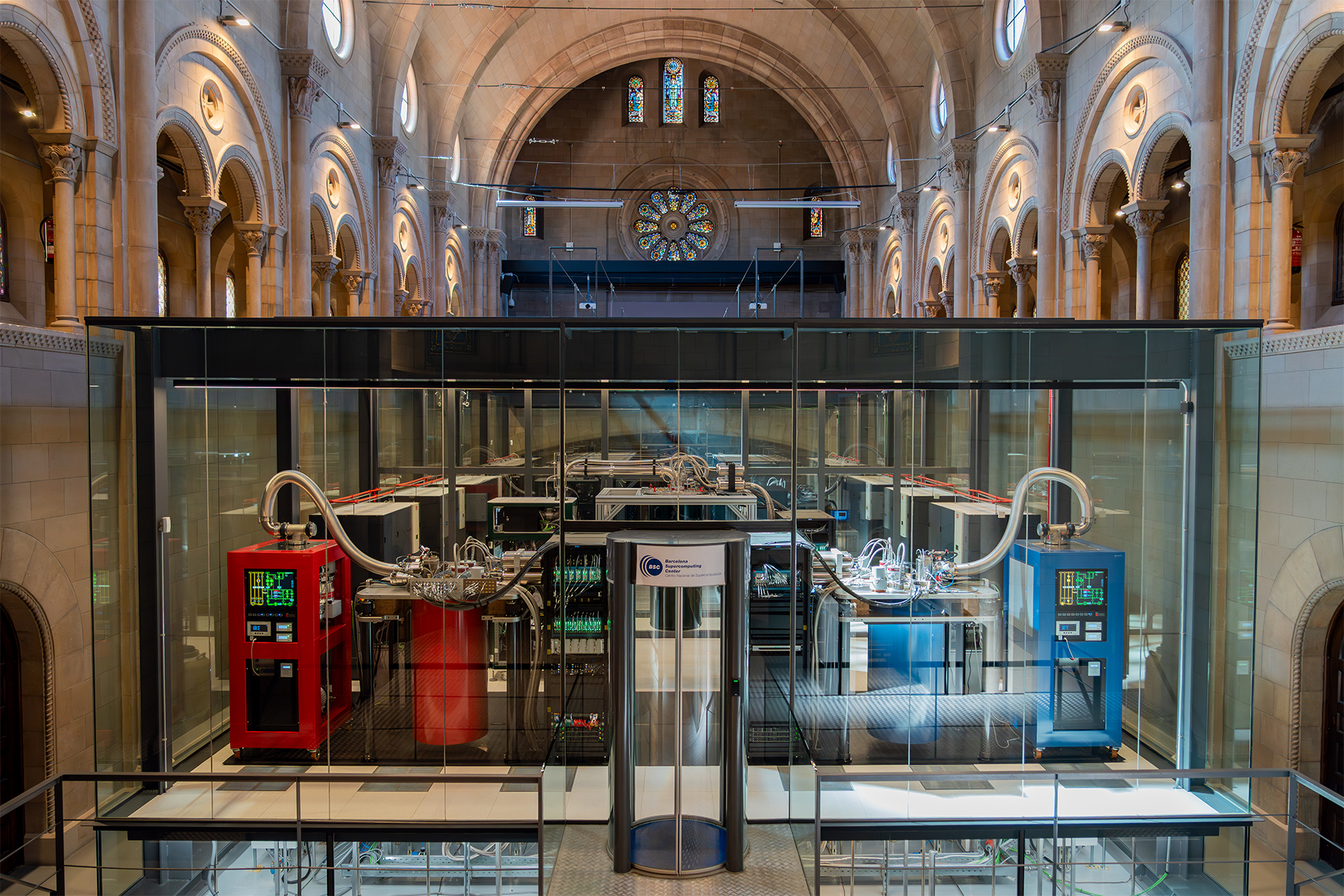
We have built an interactive version of the quantum computer that allows you to explore its components, from the golden disks to the encapsulated quantum processor—the chip that contains the qubits. A tour of the physical architecture of a technology that is often hidden behind its promise.
Seeing the Invisible
Our documentary is a hyper-realistic 3D visualization of the system that makes quantum computing possible, at a scale impossible to observe in reality. Beyond the chip, it reveals the physical structure that underpins a quantum computer: the cables that transmit signals at precise frequencies, the cooling layers, the insulating materials that protect extremely sensitive components, and the constant battle against noise that could alter the state of a qubit.
About
Creative Intelligence Lab
The Creative Intelligence Lab at the Barcelona Supercomputing Center is the first art and science laboratory integrated into a European supercomputing center. We build on more than thirteen years of work at the intersection of science, technology, and creative practices. We integrate artistic practice as a fundamental tool of scientific research, collaborating with artists, cultural institutions, and industry to raise new questions, explore new methodologies, and generate knowledge.
We are developing this project in collaboration with Nataly Buslón and Xavier Paradis.
Barcelona Supercomputing Center
The Barcelona Supercomputing Center - Centro Nacional de Supercomputación (BSC-CNS) is a leader in supercomputing in Spain and an international benchmark in Artificial Intelligence (AI) and High-Performance Computing (HPC). With more than 20 years of experience, it promotes the integration of research across its many dimensions, data management, and the development of cutting-edge infrastructure to serve the global scientific community. In addition, it coordinates the Spanish Supercomputing Network (RES) and hosts the MareNostrum 5 supercomputer and Spain’s first quantum computers.
Quantum Spain
Quantum Spain is a strategic project spearheaded by the Ministry for Digital Transformation and the Civil Service, through the Secretariat of State for Digitalization and Artificial Intelligence (SEDIA). It is coordinated by the Barcelona Supercomputing Center and funded through the Recovery, Transformation, and Resilience Plan, as part of the España Digital 2026 strategy. The initiative aims to promote the development of a national quantum computing ecosystem and includes the launch of the first quantum computer developed with 100% European technology, as well as the promotion of research, the development of algorithms and applications, and the training of specialized talent.